


A angārs is a closed building structure to hold lidmašīna or kosmosa kuģis. Hangars are built of metal, wood, or concrete. The word angārs comes from Middle French hanghart ("enclosure near a house"), of Germanic origin, from Frankish haimgarda ("home-enclosure", "fence around a group of houses"), from haim ("home, village, hamlet") and gard ("yard"). gard comes from the Old Norse garðr ("enclosure, garden").
Angāri tiek izmantoti aizsardzībai pret laikapstākļiem, tiešiem saules stariem un lidmašīnu apkopei, remontam, ražošanai, montāžai un uzglabāšanai.
Saturs
Vēsture
 | This article needs additional citations for pārbaude. Please help uzlabot šo rakstu by Citu pievienošana uzticamiem avotiem. Materiālu bez avota var apstrīdēt un noņemt. Atrodiet avotus: "Hangar" – ziņas · avīzes · grāmatas · zinātnieks · JSTOR (2019. gada augusts) (Uzziniet, kā un kad noņemt šo veidnes ziņojumu) |
 The Raits lidotājs outside the aircraft's makeshift hangar
The Raita brāļi stored and repaired their aircraft in a wooden hangar constructed in 1902 at Nogalini Devil Hills in Ziemeļkarolīna for their planieris. After completing design and construction of the Raits lidotājs in Ohaio, the brothers returned to Kill Devil Hills only to find their hangar damaged. They repaired the structure and constructed a new workshop while they waited for the Skrejlapa to be shipped.
 Kārlis Ričards Nībergs's hangar for his Flugan (fly) from 1908, Täcka udden in Lidingö, Zviedrija
Kārlis Ričards Nībergs used a hangar to store his 1908 Flugan (fly) in the early 20th century and in 1909, Luiss Bleriots crash-landed on a northern French farm in Les Baraques (between Sangatte and Kalē) and rolled his monoplāns into the farmer's cattle pen. Bleriot was in a race to be the first man to cross the angļu kanāls in a smagāks-par-gaisu aircraft, and he and set up his headquarters in the unused shed. In Britain, the earliest aircraft hangars were known as lidmašīnu nojumes, and the oldest survivors of these are at Larkhill, Wiltshire. These were built in 1910 for the Bristol School of Flying and are now Grade II Sarakstā iekļautās ēkas. British aviation pioneer Aliots Verdons Rū built one of the first aeroplane sheds in 1907 at Brūklenda, Surrey and full-size replicas of this and the 1908 Roe biplane are on display at Bruklendas muzejs.
As aviation became established in Britain before World War I, standard designs of hangar gradually appeared with military types too such as the Besonneau angārs and the side-opening aeroplane shed of 1913, both of which were soon adopted by the Karaliskais lidojošais korpuss. Examples of the latter survive at Fārnboro, Filtons and Montrose airfields. During World War I, other standard designs included the RFC General Service Flight Shed and the Admiralty F-Type of 1916, the General Service Shed (featuring the characteristic Belfāstas{0}}fermas roof and built-in various sizes) and the Hendlija lapa aeroplane shed (1918).
Būvniecība
Tērauda konstrukcijarediģēt
Sheds built for rigid airships survive at Mofetfīlda, Kalifornija; Akron, Ohaio; Weeksville, Ziemeļkarolīna; Leikhērsta, Ņūdžersija; Santakrusas gaisa spēku bāze in Brazil; and Kārdingtona, Bedfordšīra. Tērauda cietie dirižabļu angāri ir vieni no lielākajiem pasaulē.
Hangar 1, Lakehurst, is located at Leikhērstas jūras spēku gaisa inženierijas stacija (formerly Naval Air Station Lakehurst), New Jersey. The structure was completed in 1921 and is typical of airship hangar designs of World War I. The site is best known for the Hindenburga disaster, when on May 6, 1937, the German airship Hindenburga crashed and burned while landing. Hangar No.1 at Lakehurst was used to build and store the American USS Šenando. The hangar also provided service and storage for the airships USS Losandželosa, Akron, Makons, as well as the Grafs cepelīns and the Hindenburga.
The largest hangars ever built include the Goodyear Airdock measuring 1,175x325x211 feet1 and Hangar One (Mountain View, Kalifornija) measuring 1,133 ft 308 ft 198 ft (345 m 94 m 60 m). The Goodyear Airdock, is in Akron, Ohio and the structure was completed on November 25, 1929. The Airdock was used for the construction of the USS Akron and her sister ship, the USS Makons.
Viens angārs at Mofeta federālais lauks (formerly Jūras spēku gaisa stacijas Mofeta lauks), is located in kalnu ainava, California. The structure was completed in 1931. It housed the USS Makons.
Auduma konstrukcija
Main article: CargoLifter
A hangar for Cargolifter was built at Zīmols-Brīzenas lidlauks 1,180 ft (360 m) long, 705 ft (215 m) wide and 348 ft (106 m) high and is a free standing steel-dome "barrel-bowl" construction large enough to fit the Eifeļa tornis on its side. The company went into maksātnespēja and in June 2003, the facilities were sold off and the dirižabļu angārs was converted to a 'tropical paradise'-themed indoor holiday resort called Tropu salas, kas tika atvērts 2004.
An alternative to the fixed hangar is a portable shelter that can be used for aircraft storage and maintenance. Portable auduma konstrukcijas can be built up to 215 ft (66 m) wide, 100 ft (30 m) high and any length. They are able to accommodate several aircraft and can be increased in size and even relocated when necessary.nepieciešama atsauce
Konstrukcijas un izmēri
Angāru būvniecībai nepieciešamas īpašas konstrukcijas. Durvju platumam jābūt lielam; tas ietver gaisa kuģa ieeju. Jo lielāks ir ieviešamais gaisa kuģis, jo sarežģītāka ir nepieciešama struktūra. Pēc angāra platuma izmērus var klasificēt šādi:
| Izmērs | Laipne (metri) |
|---|---|
| S | Mazāk par 30 m |
| M | 30–60 m |
| L | 60–90 m |
| XL | 90–120 m |
| XXL | Vairāk nekā 120 m |
XXL hangars are built for the largest aircraft in the world like the Airbus A380, Boeing 747 and the Antonovs 225, kuras ir visgrūtāk uzcelt.4
regula
Angārus parasti regulē būvnormatīvi valstīs un jurisdikcijās un lidostās, kurās tie dzīvo. 2014. gada augustā Amerikas FAA ierosināja tiesību aktus par to, kā angāru var izmantot lidlaukos, kas saņem valsts finansējumu. Atļauto darbību definīcija ietvēra gaisa kuģu galīgo montāžu.5
Dirižabļu angāri
Dirižabļu angāri or airship sheds are generally larger than conventional aircraft hangars, particularly in height. Most early airships used ūdeņradis gas to provide them with sufficient buoyancy for flight, so their hangars had to provide protection from stray sparks to keep the gas from exploding. Hangars that held several airships were at risk from chain-reaction explosions. For this reason, most hangars for hydrogen-based airships were built to house only one or two such craft. During the "Golden Age" of airship travel from 1900, mooring masts and sheds were constructed to build and house airships. The British government built a shed in Karači for the R101, the Brazilian government built one in Riodežaneiro, the pt: Hangar do Zeppelin for the German Cepelīni, and the U.S. government constructed Mofeta lauks, kalnu ainava, California and Leikhērstas jūras spēku gaisa stacija, Leikhērsta, Ņūdžersija.
Angāri uz kuģiem
_at_JMSDF_Maizuru_Naval_Base_July_29,_2017_02.jpg) The helicopter hangar of an Akizuki-klase iznīcinātājs.
The helicopter hangar of an Akizuki-klase iznīcinātājs.
Many karakuģi carry aircraft and will often have hangars for storage and maintenance. Such hangars may be situated adjacent to the lidojumu kabīne on kreiseri, iznīcinātāji and fregates or underneath the flight deck with lifti to lift the aircraft on gaisa kuģu pārvadātāji and amfībijas uzbrukuma kuģi. Uz dažiem kuģiem, kur vietas ir maz, angāram un pilotu klājam ir viena telpa, un angārs ir novietots lidojuma vajadzībām.
Galerija
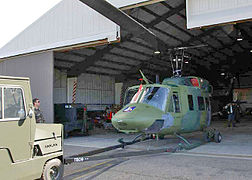
Hangars can hold fiksēta{0}}spārna lidmašīna, rotācijas -spārnu lidmašīna (helikopteri), and vieglāki-nekā-aviokuģi.
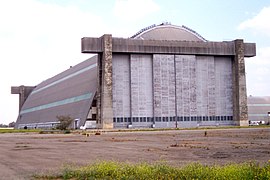
Angārs Nr.2 at the former Jūras korpusa gaisa stacija Tustin is 1,072 ft (327 m) long, 292 ft (89 m) wide and 192 ft (59 m) tall.

Lidmašīnai Airbus A319 tiek veikta apkope angārā.
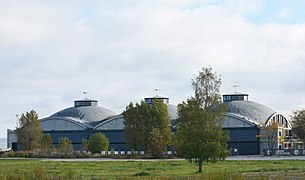
Hangars for hidroplāni of the Krievijas impērijas gaisa spēki in Tallina harbor - some of the first dzelzsbetons structures

A General Dynamics F-16 Fighting Falcon in front of a Rūdīta gaisa kuģu patversme, īpašs angāra veids
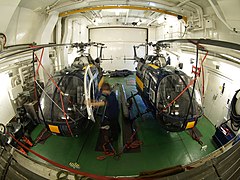
Helicopter hangar of the German research vessel Polaršterns

A medium-sized aircraft hangar at Kembles lidosta, Anglija

Hangar of Iberia Airlines (XXL-150m span) Barselonas lidosta, Spānija
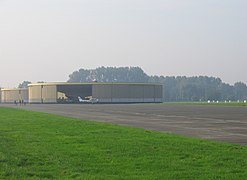
Round concrete hangars at Grimbergenas lidlauks, Beļģija.
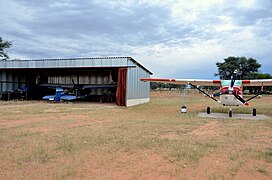
Private Hangar on a saimniecība in Namībija (2017)


.jpg)
